A Complete Guide to UV Printing Machines, Their Features, Uses, and Functions
UV printing machines are digital printing systems that use ultraviolet light to cure specially formulated ink immediately after it is deposited onto a surface.
Unlike conventional printing methods that may require extended drying, UV printing uses a curing process that quickly hardens the ink layer.
These machines can print on many rigid and flexible materials, including acrylic, glass, wood, metal, plastics, tiles, coated boards, films, and selected specialty media. Their applications range from signage and displays to product decoration, packaging prototypes, labels, interior graphics, and customized objects.
Context
UV printing is a form of digital inkjet printing. The printer places very small droplets of UV-curable ink onto the selected substrate, while UV lamps or UV-LED units cure the ink almost immediately. This creates a solid printed layer on the surface.
The technology developed as an alternative to processes that depend on long drying periods or specific absorbent substrates. Because the ink is cured rather than simply dried, UV printing can work with many non-porous materials.
There are three common UV printing machine configurations:
| Machine type | Main material format | Typical applications |
|---|---|---|
| Flatbed UV printer | Rigid sheets and objects | Acrylic, glass, wood, tiles, boards |
| Roll-to-roll UV printer | Flexible rolls | Films, vinyl, wallpaper, flexible graphics |
| Hybrid UV printer | Rigid and flexible media | Mixed-material production |
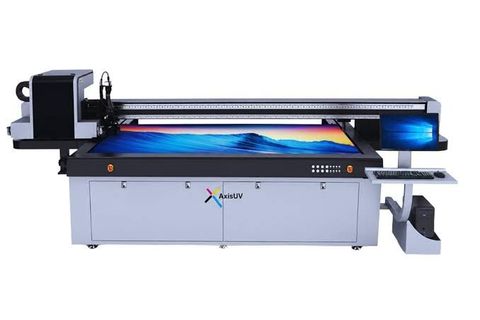
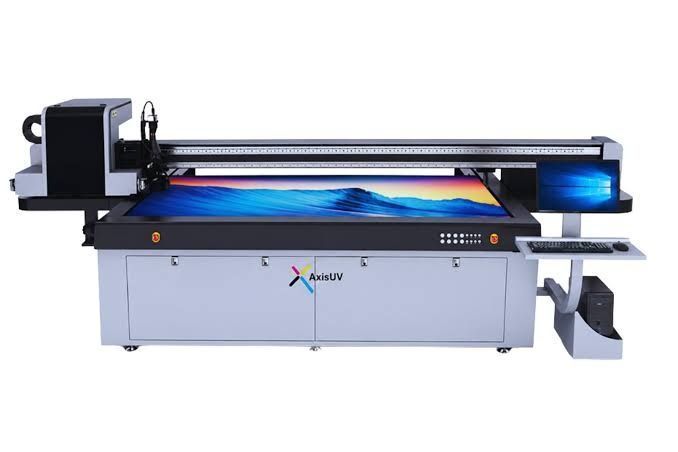
Flatbed systems hold the substrate on a stationary table while the print carriage moves across it. Roll-to-roll systems transport flexible material from one roll through the printer. Hybrid systems combine both approaches.
A UV printing machine generally includes printheads, ink reservoirs, UV curing units, a media-handling system, a control system, and RIP or workflow software. Depending on the machine, additional features may include vacuum tables, automatic height detection, white ink, varnish, primer, texture effects, and camera-based registration.
Importance
UV printing machines matter because they expand the range of materials that can receive digitally printed graphics. Traditional inkjet processes often depend on the surface absorbing or accepting ink in a particular way, while UV-curable systems can create a cured layer on many different substrates.
The technology is relevant to several groups:
- Sign and display producers
- Packaging and prototype teams
- Interior and architectural graphics specialists
- Product decorators
- Industrial manufacturers
- Educational and research facilities
- Small-format customized-object producers
One important feature is the ability to print white ink. White ink can act as a base layer on dark or transparent materials, allowing colors to remain visible. Some systems can also apply clear or textured layers for visual and tactile effects.
The main functions of a UV printing machine can be summarized as follows:
- Image processing through RIP software
- Precise inkjet deposition
- UV curing of deposited ink
- Multi-layer printing
- White-ink underprinting or overprinting
- Clear or varnish-layer application on supported systems
- Registration and media positioning
- Production of graphics on selected rigid or flexible substrates
Material compatibility should always be tested before production. A printer specification alone does not establish that every substrate will produce the same adhesion, durability, color, or surface appearance.
Recent Updates
UV printing technology continues to develop around automation, workflow control, curing systems, print quality, and material flexibility.
Recent developments include greater integration of automated media handling and camera-based positioning. In September 2026, Mimaki announced new UJF200-series flatbed UV printers with fluorescent UV inks, while optional camera and belt systems are designed to support greater printing-process automation.
Automation is also becoming more closely connected with RIP software and production workflows. Current industry developments include automatic nozzle monitoring, media alignment, nesting, multi-layer setup, remote monitoring, and workflow data collection.
Another continuing development is the use of UV-LED curing. UV-LED systems can provide rapid curing while avoiding some characteristics associated with older curing technologies. However, actual energy use and performance depend on machine configuration, curing power, ink formulation, print speed, and operating conditions.
Current UV printers are also being developed for more specialized applications. These include direct-to-object printing, textured graphics, decorative surfaces, packaging prototypes, industrial identification, and variable-data printing.
When evaluating recent developments, it is useful to consider more than maximum print speed. Important technical factors include print resolution, number of printheads, ink configuration, curing method, substrate compatibility, automation features, workflow software, maintenance requirements, and environmental conditions.
Laws or Policies
Regulatory requirements vary according to the country, substrate, ink formulation, workplace, and final application. A UV printer itself is not subject to one universal global regulation.
In India, printers and plotters appear in the Bureau of Indian Standards' list under the Compulsory Registration Scheme, with the applicable standard identified as IS/IEC 62368 Part 1:2023 on the current BIS information page. Applicability should be checked for the specific equipment and configuration before procurement or import.
India's E-Waste (Management) Rules, 2022 came into force on April 1, 2023 and apply to specified electrical and electronic equipment and related activities. The rules have also been amended, so organizations handling electronic equipment should consult the latest government notifications.
BIS states that certification is generally voluntary unless a product has been made subject to compulsory requirements through government notification or a Quality Control Order. Therefore, compliance should be determined from the exact product category rather than assumed for every UV printer.
Environmental requirements can also concern ink composition, emissions, waste handling, ventilation, and workplace practices. In the United States, EPA materials recognize UV-cured inks and coatings among low- or no-VOC/HAP formulations, while applicable air-emission requirements depend on the particular operation and regulatory category.
For organizations operating in the European Economic Area, REACH requirements can apply to chemical substances used in industrial processes and products. The European Commission explains that REACH establishes requirements for identifying, managing, registering, and restricting certain chemical substances.
Tools and Resources
Several resources can help users understand and operate UV printing equipment more systematically.
Useful resources include:
- BIS databases for applicable Indian standards and registration requirements
- Government environmental portals for waste-management rules
- EPA resources for air emissions and printing-related environmental requirements
- European Commission REACH information for chemical compliance
- Manufacturer technical manuals for machine specifications
- RIP software documentation for color and workflow settings
- ICC color profiles for supported media
- Substrate testing sheets for adhesion and curing evaluation
- Preventive-maintenance checklists for printheads, ink systems, and curing units
A practical substrate-testing checklist can include:
| Test area | What to check |
|---|---|
| Adhesion | Whether cured ink remains attached |
| Color | Accuracy and consistency |
| Curing | Whether the ink is fully cured |
| Surface | Gloss, matte, texture, or other finish |
| Durability | Resistance to handling and environmental exposure |
| Registration | Alignment between colors and layers |
Manufacturer documentation should be used for exact operating procedures because ink, printhead, curing, and maintenance requirements differ between machines.
FAQs
What is a UV printing machine?
A UV printing machine is a digital inkjet printer that deposits UV-curable ink onto a substrate and uses ultraviolet light to cure the ink.
What materials can UV printers print on?
Depending on the machine and ink system, UV printers can work with materials such as acrylic, glass, wood, metal, plastics, tiles, boards, films, and vinyl. Compatibility should be confirmed through testing.
What is the difference between flatbed and roll-to-roll UV printing?
Flatbed UV printers are designed primarily for rigid materials and objects. Roll-to-roll systems are designed for flexible media supplied from rolls. Hybrid systems combine both formats.
What is white ink used for?
White ink can provide a base layer on transparent or dark substrates. It can also be used as part of multi-layer printing where supported by the printer and RIP software.
Does UV ink dry immediately?
UV ink is cured rapidly when exposed to the appropriate ultraviolet radiation. The curing process is different from conventional evaporation-based drying, and complete performance depends on the ink, curing system, print settings, and substrate.
Conclusion
UV printing machines combine digital inkjet technology with ultraviolet curing to print graphics onto a broad range of materials. Their major functions include precise ink deposition, rapid curing, multi-layer printing, white-ink application, and, on selected systems, clear or textured effects.
Current developments are increasingly focused on automation, workflow integration, specialized inks, improved media handling, and direct-to-object applications. Understanding machine configuration, substrate compatibility, ink characteristics, maintenance, and applicable regulations is important for using UV printing technology appropriately.
UV printing is not a single machine format or application. Flatbed, roll-to-roll, and hybrid systems address different material requirements, while specialized configurations support particular production environments.
For responsible operation, users should follow the equipment manufacturer's technical documentation and check applicable national, regional, environmental, electrical-safety, and waste-management requirements before operating or importing equipment.