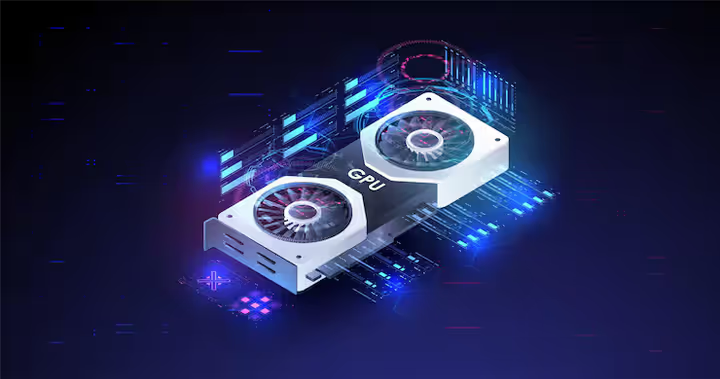
Unlike traditional Central Processing Units (CPUs), which are optimized for sequential processing, GPUs can perform many operations simultaneously. This makes them well suited for AI workloads, where models often need to process large datasets and perform repeated mathematical operations.
The rise of machine learning and deep learning created a demand for faster processing methods. As datasets grew larger and models became more complex, CPUs alone struggled to handle the workload efficiently. GPU Computing in AI emerged as a solution, enabling faster training and data processing by distributing tasks across thousands of smaller processing cores.
Today, GPU-based systems are widely used in fields such as image recognition, natural language processing, healthcare analysis, and financial modeling. They support both research and real-world applications by reducing the time required to train and deploy AI models.
Importance
GPU Computing in AI plays a significant role in improving efficiency and scalability in modern computing. As AI systems become more integrated into daily life, the need for faster and more reliable processing continues to grow.
One major advantage is speed. GPUs can process multiple data points at the same time, which significantly reduces the time required for training machine learning models. Tasks that might take days on a CPU can often be completed much faster using GPU acceleration.
Another important factor is scalability. AI models are becoming increasingly complex, with millions or even billions of parameters. GPUs enable these models to scale without causing major delays in processing.
Key ways GPU Computing in AI addresses real-world challenges include:
-
Faster model training: Reduces waiting time for developers and researchers working on AI systems.
-
Efficient data handling: Allows processing of large datasets such as images, videos, and text.
-
Improved accuracy: Enables the use of more complex models that can capture patterns more effectively.
-
Real-time processing: Supports applications like speech recognition and recommendation systems.
For everyday users, these improvements translate into smoother digital experiences. Applications powered by AI, such as virtual assistants or content recommendations, become more responsive and reliable.
Recent Updates
Recent trends in GPU Computing in AI reflect rapid advancements in both hardware and software. One noticeable development is the introduction of specialized AI-focused GPU architectures. These designs are optimized for machine learning tasks, improving performance and energy efficiency.
Another trend is the growth of cloud-based GPU access. Instead of relying solely on local hardware, organizations can use remote computing platforms to run AI workloads. This has made GPU resources more accessible to a wider range of users.
There is also increasing integration between GPUs and AI frameworks. Popular machine learning libraries now include built-in support for GPU acceleration, allowing developers to utilize hardware capabilities without extensive configuration.
Energy efficiency has become an area of focus as well. Newer GPU models are designed to deliver higher performance while consuming less power, addressing concerns about the environmental impact of large-scale AI training.
Additionally, there is growing interest in combining GPUs with other types of processors, such as Tensor Processing Units (TPUs) and specialized accelerators. This hybrid approach aims to further optimize performance for specific AI tasks.
Laws or Policies
GPU Computing in AI is influenced by various laws and policies related to data usage, digital infrastructure, and technology governance. While GPUs themselves are hardware components, their use in AI systems must comply with broader regulatory frameworks.
In India, data protection regulations such as the Digital Personal Data Protection Act affect how data is processed during AI training. Organizations must ensure that personal data used in AI models is handled responsibly and securely.
Government initiatives related to digital infrastructure also play a role. Programs promoting data centers, cloud computing, and high-performance computing contribute to the growth of GPU-based AI systems.
Other relevant policy areas include:
-
Data privacy rules: Require secure handling and storage of user data.
-
Cybersecurity guidelines: Ensure systems using GPU computing are protected against threats.
-
Export and technology regulations: May influence the availability of advanced hardware in certain regions.
-
Environmental policies: Address energy consumption associated with large-scale computing systems.
These frameworks shape how GPU Computing in AI is implemented, encouraging responsible and sustainable use.
Tools and Resources
A variety of tools and resources support GPU Computing in AI, helping developers, researchers, and organizations manage workloads effectively.
Common tools include:
-
AI frameworks: Platforms such as TensorFlow and PyTorch provide built-in support for GPU acceleration.
-
GPU drivers and libraries: Software like CUDA and OpenCL enable communication between hardware and applications.
-
Cloud computing platforms: Provide access to GPU-enabled environments for training and data processing.
-
Monitoring tools: Help track performance, memory usage, and processing efficiency.
-
Educational platforms: Offer tutorials and documentation for learning GPU-based AI development.
Below is a table comparing CPU and GPU characteristics in AI workloads:
| Feature | CPU (Central Processing Unit) | GPU (Graphics Processing Unit) |
|---|
| Processing Style | Sequential processing | Parallel processing |
| Core Count | Few cores (optimized for complex tasks) | Many cores (optimized for repetitive tasks) |
| Speed for AI Tasks | Slower for large datasets | Faster for large-scale computations |
| Energy Usage | Moderate | Higher but improving with newer designs |
| Use Case | General computing tasks | AI training, data processing, graphics |
| Scalability | Limited for heavy AI workloads | High scalability for complex models |
These tools and comparisons help users understand how GPU Computing in AI improves efficiency and supports advanced applications.
FAQs
What is GPU Computing in AI and why is it important?
GPU Computing in AI refers to using GPUs to perform calculations required for artificial intelligence tasks. It is important because it speeds up data processing and enables more complex models to be trained efficiently.
How does GPU Computing in AI improve model training?
GPUs process multiple operations simultaneously, allowing large datasets to be handled faster. This reduces the time required to train machine learning models and improves overall efficiency.
Can GPU Computing in AI be used for small projects?
Yes, GPU Computing in AI can be used for projects of different sizes. Even smaller projects can benefit from faster processing and improved performance.
What is the difference between CPU and GPU in AI tasks?
CPUs handle tasks sequentially and are suitable for general computing, while GPUs perform parallel processing. This makes GPUs more effective for AI workloads that involve large-scale data and repetitive calculations.
Do all AI applications require GPU Computing in AI?
Not all applications require GPUs. Simpler models or smaller datasets can run on CPUs, but more complex tasks often benefit from GPU acceleration.
Conclusion
GPU Computing in AI has become an essential component of modern data processing and machine learning. By enabling parallel computation, GPUs significantly reduce the time required for training and analyzing large datasets. Advances in hardware, software integration, and cloud access continue to expand their role in AI development. Understanding how GPUs function in AI systems helps explain the speed and efficiency behind many technologies used in everyday life.